

Be sure to also watch the 20-Minute Tips videos on Academic CVs and Academic Cover Letters.
Getting Started with CVs and Cover Letters
Every graduate student needs a curriculum vitae, or CV
Your CV represents your accomplishments and experience as an academic and helps to establish your professional image. Well before you apply for faculty positions, you will use your CV to apply for fellowships and grants, to accompany submissions for publications or conference papers, when being considered for leadership roles or consulting projects, and more. CVs are also used when applying for some positions outside academia, such as in think tanks or research institutes, or for research positions in industry.
As you progress through graduate school, you will, of course, add to your CV, but the basic areas to include are your contact information, education, research experience, teaching experience, publications, presentations, honors and awards, and contact information for your references, or those people willing to speak or write on your behalf.
Some formatting pointers:
- There is no single best format. Refer to samples for ideas but craft your CV to best reflect you and your unique accomplishments.
- Unlike a resume, there is no page limit, but most graduate student CVs are two to five pages in length. Your CV may get no more than thirty seconds of the reader’s attention (if you’re lucky!), so ensure the most important information stands out. Keep it concise and relevant!
- Be strategic in how you order and entitle your categories. The most important information should be on the first page. Within each category, list items in reverse chronological order. Category headings influence how readers perceive you. For example, the same experience could belong in a category entitled: “Service to the Field,” “Conferences Organized,” or “Relevant Professional Experience.”
- Use active verbs and sentence fragments (not full sentences) to describe your experiences. Avoid pronouns (e.g. I, me), and minimize articles (a, and, the). Use a level of jargon most appropriate for your audience.
- Keep locations, dates and less important information on the right side of the page – the left side should have important details like university, degree, job title, etc.
- Stick to a common font, such as Times New Roman, using a font size of 10 to 12 point. Use highlighting judiciously, favoring bold, ALL CAPS, and white space to create a crisp professional style. Avoid text boxes, underlining, and shading; italics may be used in moderation. Margins should be equal on all four sides and be ¾ to 1 inch in size.
- And most importantly… Follow the conventions of your field! Different academic disciplines have different standards and expectations, especially in the order of categories. Check out CVs from recent graduates of your department and others in your field, to ensure you are following your field’s norms.
Tailor your CV to the position, purpose, or audience
“Why should we select YOU?” – That is the question on the top of your reader’s mind, so craft your CV to convince the reader that you have the skills, experience, and knowledge they seek. Depending on the purpose, you might place more or less emphasis on your teaching experience. Also, keep an archival CV (for your eyes only!) that lists all the details of everything you’ve done – tailor from there.
______________________________________________
For more detailed guidance, watch the MCS 20-Minute Tips video: Academic CVs
Describe your experiences with these action verbs
Many CV categories will be simple lists with little or no elaboration, e.g. Publications, Presentations, etc. However, in presenting relevant experiences (e.g. Teaching Experience, Museum Experience, Related Professional Experience, etc), you may want to use bullet points with brief descriptions of your accomplishments. Begin each bullet with an active verb, use sentence fragments, avoid personal pronouns (e.g. I, we), and minimize articles (a, an, the). See example CVs below.
Achievement
accelerated
accomplished
achieved
activated
attained
competed
earned
effected
elicited
executed
exercised
expanded
expedited
generated improved
increased
insured
marketed
mastered obtained
produced
reduced
reorganized
reproduced
restructured
simplified
sold
solicited
streamlined
succeeded
upgraded
Administrative
arranged
channeled
charted
collated
collected coordinated
dispensed
distributed
established
executed
implemented
installed
maintained
offered ordered
outlined
performed
prepared
processed
provided
purchased
recorded
rendered
served
serviced
sourced
supported
Communication
addressed
arbitrated
articulated
briefed
communicated
conducted
contacted
conveyed
corresponded
delivered
demonstrated
edited
entertained
interviewed
informed
lectured
mediated
negotiated
persuaded
presented
promoted
proposed
publicized
reported
represented
responded
suggested
translated
wrote
Creative
authored
changed
conceived
constructed
created
developed
devised
drafted
established
formulated
founded
illustrated
influenced
introduced
invented
launched
originated
revamped
revised
staged
updated
visualized
Financial
allocated
analyzed
appraised
audited
balanced
budgeted
calculated
compiled
computed
controlled
disbursed
estimated
figured
financed
forecasted
projected
reconciled
tabulated
Help/Tech
advised
clarified
coached
collaborated
consulted
counseled
educated
explained
facilitated
guided
helped
instructed
modeled
participated
taught
trained
tutored
Lead/Manage
acquired
administered
approved
assigned
chaired
contracted
controlled
decided
delegated
directed
enlisted
governed
handled
initiated
instilled
instituted
managed
motivated
presided
recruited
retained
reviewed
selected
shaped
supervised
Plan/Organize
allocated
anticipated
arranged
catalogued
categorized
classified
collected
consolidated
convened
edited
eliminated
employed
gathered
grouped
monitored
organized
planned
regulated
scheduled
structured
summarized
targeted
Research/Analytical
assessed
compared
critiqued
defined
derived
detected
determined
discovered
evaluated
examined
explored
found
inspected
interpreted
investigated
located
measured
observed
predicted
rated
recommended
researched
reviewed
searched
studied
surveyed
verified
Technical
adapted
adjusted
applied
built
computed
constructed
designed
diagnosed
engineered
experimented
maintained
modified
operated
prescribed
programmed
proved
reinforced
repaired
resolved
restored
solved
specified
systematized
tested
CV Examples
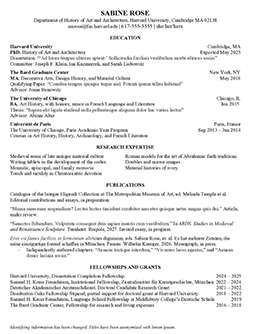
Click on the image below for downloadable CV samples (pdf).
Cover Letter Guidelines
Your Name
Department, Harvard University
City, State Zip Code
Month Day, Year
Contact Name
Title (if known)
Department, Univ./Institution Name
City, State Zip Code
Inquire with your department administrator whether you can use the departmental letterhead. If so, remove your personal contact information at the top of the letter. If not, you could use the same header as your CV.
Street addresses are not typically included, since most communication is purely electronic, but it’s still a good idea to include the academic department and university/institution’s name.
Note that in an e-mail message, you would omit both your and the addressee’s contact information, as well as the date. Simply start with the salutation.
If you include the cover letter as an attachment, use proper letter format, as shown here.
Dear Professor/Dr. Last Name: (or if not known: “Dear Members of the Search Committee:”)
Opening paragraph: Clearly state why you are writing. If applying for a specific job, indicate the position title and department. If you were referred to the position from someone within the institution, or by someone the addressee knows, mention that as well. Give a brief introduction of yourself and your status, e.g. “I am completing my PhD in [department or field] with an expected degree [or defense] in [Month, Year]. You could also include the title of your dissertation or the topic of your research and the name of your advisor.
Middle paragraphs: You should have several paragraphs that elaborate on how your research and other experiences in graduate school have prepared you for the job as it is described. Typically, these include a paragraph about your dissertation/current research, one about your future research plans, and one or two about your teaching experience/interests/approach/courses you could offer.
If you mention particular publications, fellowships, or other achievements, gracefully integrate them into the letter. For example, “Having recently won the XYZ fellowship, I investigated…” Contextualize your accomplishments rather than simply listing them (i.e. avoid “CV in prose”).
Disciplines differ on the length and level of detail required for cover letters, so be sure to get feedback from others in your department. Junior faculty members who have recently been on the market themselves are often the best people to ask. For example, the amount of detail you provide about your teaching depends on the position, the type of institution, and the norms in your field.
Tailoring: Think about how your interest in both the job and the institution developed—in order to stand out from the potentially long list of applicants, you will need to make a coherent argument for why it was a logical decision on your part to apply for the position, and why it would be a logical decision on their part to hire you. What kind of contribution will you make to their existing department? How will you fit in? Make sure you are writing for your target audience. For instance, for a liberal arts college you may use more space addressing your teaching experience than you would for a large research university. For a school outside a major metropolitan area, you may also want to indicate why you are interested in living in that area. You might include this information as a paragraph and/or you could tailor the letter throughout.
Closing paragraph: You might indicate that your CV and other supporting documentation are enclosed, or mention that letters from your referees are forthcoming. Indicate your willingness to provide additional information and express interest in speaking with the addressee further in an interview. Thank them for their time and consideration.
Sincerely,
(scanned signature—optional but a nice touch)
Name (typed)
Phone number and email address
______________________________________________
For more detailed guidance, watch the MCS 20-Minute Tips video: Academic Cover Letters
Cover Letter Examples
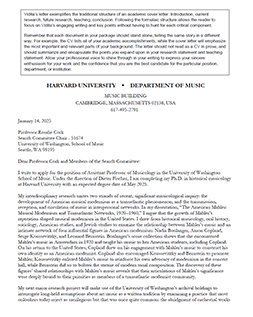
Click on the image below for downloadable cover letter samples (pdf).